University Bus Tracking System
A Java Swing and MySQL desktop app that makes university transport easier to monitor for students, drivers and administrators, built with Team ByteBrains.
- Java
- Java Swing
- MySQL
- JDBC
- NetBeans
- XAMPP
Team desktop project built with Team ByteBrains. There is no public demo or repository for this one.
Why we built it
The idea was simple: how can we make university transportation easier to monitor and more convenient for students, drivers and administrators? We built the system as a team project with Team ByteBrains (Shahriar, Asit and me), and treated it as a real problem instead of a classroom exercise.
What it does
It is a Java Swing desktop application backed by MySQL, designed around three roles:
- Admin: manages buses, routes, drivers, approvals and feedback, and views fleet statistics and reports.
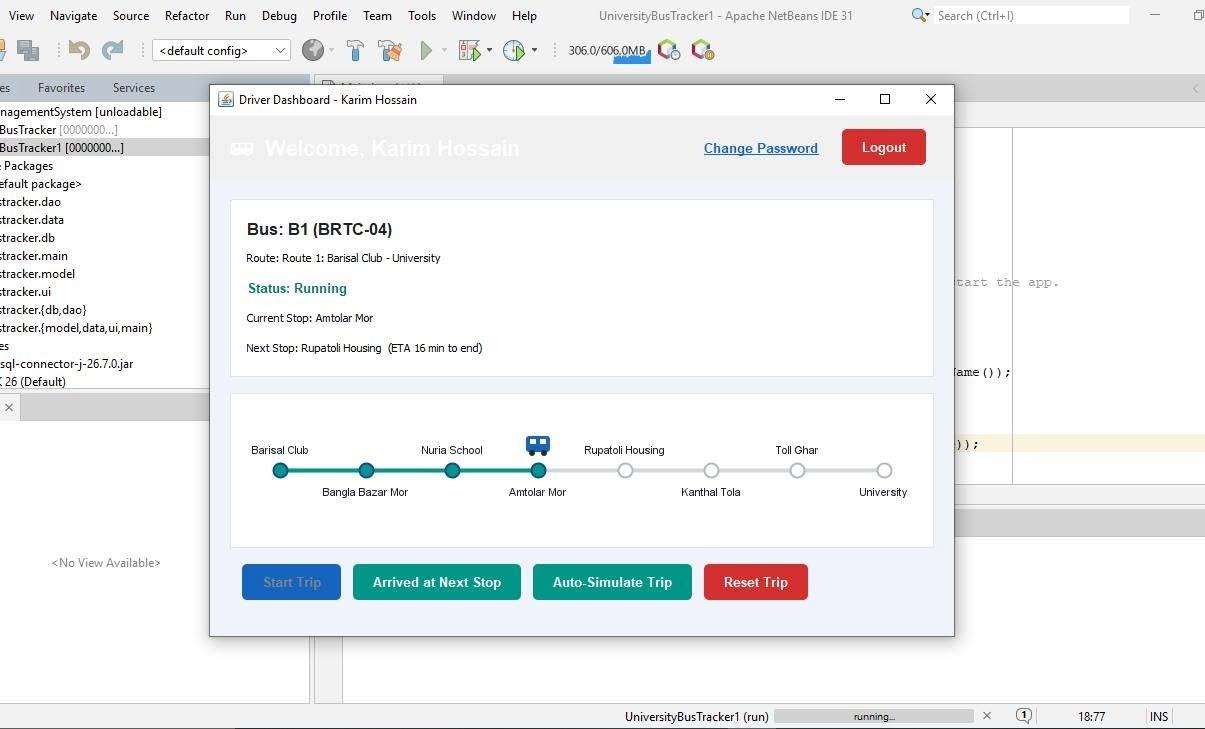
- Driver: starts a trip and updates the bus as it moves along the assigned route.
- Student: selects a route, monitors buses, sees estimated arrival information, checks schedules and submits feedback.
Instead of arbitrary sample data, we grounded the system in real university transportation information: route names, stop sequences, bus identifiers and published departure schedules.
Stack
| Purpose | Technology |
|---|---|
| Language | Java |
| Interface | Java Swing |
| Database | MySQL, served locally with XAMPP |
| Connectivity | JDBC |
| IDE | NetBeans |
Technical decisions
Simulated live tracking
Real GPS hardware was outside the scope of the project, so we simulated tracking with a current_stop_index. The bus position changes as the trip progresses, and the dashboards periodically poll the database so every role sees the same state.
A layered, DAO-based design
Database access goes through DAO classes using PreparedStatement for safer SQL, on top of a schema with primary and foreign key relationships. Because the layers are separate, the tracking mechanism can be replaced with a real GPS data source later without redesigning the whole application.
Reports
Admins can export CSV reports from the fleet data.
Challenges
- No GPS hardware. Real-time tracking was outside the scope, so we simulated the bus position with a
current_stop_indexand polled the database to keep every dashboard in sync. - Three roles, one source of truth. Admin, driver and student screens needed different permissions and actions without duplicating business logic.
- Modelling real transport data. We used real route names, stop sequences, bus identifiers and published schedules, so the schema had to represent the domain rather than arbitrary sample rows.
- Desktop GUI plus database. Java Swing, JDBC, DAO classes and MySQL with XAMPP all had to work together, including prepared statements and key relationships.
- Team delivery. We divided the work across three people and had to keep the database schema and UI behaviour aligned.
What I learned
- A good software solution is not only about writing code. It is about modelling the real problem properly.
- Java Swing and GUI development, MySQL database design, JDBC, DAO architecture, key relationships, role-based workflows and polling all had to work together in one complete system.
- Connecting database design, application architecture, user roles and real-world requirements is where most of the learning happened.
Future improvements
- Replace the simulated tracking with a real GPS feed.
- Add notifications for delays and arrivals.
- Build a web or mobile companion so students do not need the desktop app.
- Improve ETA calculations using historical trip data.